
By Ike Riser

Early in my career, despite the massive responsibility of working with and around cranes, my company assigned me various crane pick tasks without giving me crane safety training. Too many businesses fail to provide proper training, which can lead to disastrous consequences.
Filled with excitement, I started my first day in heavy civil construction fascinated by the heavy equipment and crane activity. My enthusiasm ended quickly when a load fell from a crane and fatally struck a colleague.
Following the events of that day, I learned all I could about cranes and crane safety. I became a foreman and subsequently a superintendent, who, above all, focused on keeping people safe.
Common causes of crane accidents
People commonly take for granted the power, magnitude, and scale of cranes. The assumption everything will go smoothly is often the greatest cause of crane accidents. People assume, for example, a load will land safely once the operator lifts it, the rigging will properly support the load, and workers are out of harm’s way.
We cannot assume anything with crane operations — assumptions can get people killed.
Before a project begins, we must know with certainty it will go smoothly and the rig has the capacity to pick what it’s scheduled to pick. It does not take much for an operation to go wrong, and once a mistake occurs, it’s too late to address it. We must go over each step in preparation for a pick, follow the pick-plan procedures, and take all necessary precautions.
Mistakes that lead to crane accidents
Without providing comprehensive crane safety training, businesses set their employees and operations up for failure.
In addition, everyone involved in an operation needs to avoid the following crane safety mistakes:
Putting total trust in the operator: Confirm the operator followed the protocols and has the needed information. Clear the area of hazards and ensure all involved in the operation follow the lift director’s pick-plan. Also consider the weight of the object, angle, rigging, distance, and capacity of the crane.
Trusting the crane will work as intended: Operators need to thoroughly inspect the crane prior to each shift and prohibit people from working underneath the hoisted load.
Taking for granted the crane can carry a load: The lift director must check the crane’s capability to ensure the pick can be placed at the desired location. Keep in mind, the farther away the destination, the less capacity the crane has.
Dedicating less attention to smaller loads: Large, complex picks typically go more smoothly because crews put a lot of thought into the pick. Crews can stumble with smaller picks, however, if they don’t pour the same level of dedication into them.
Failing to ask, “What if?”: Preparing for the what-ifs keeps us alive. For each crane pick, consider: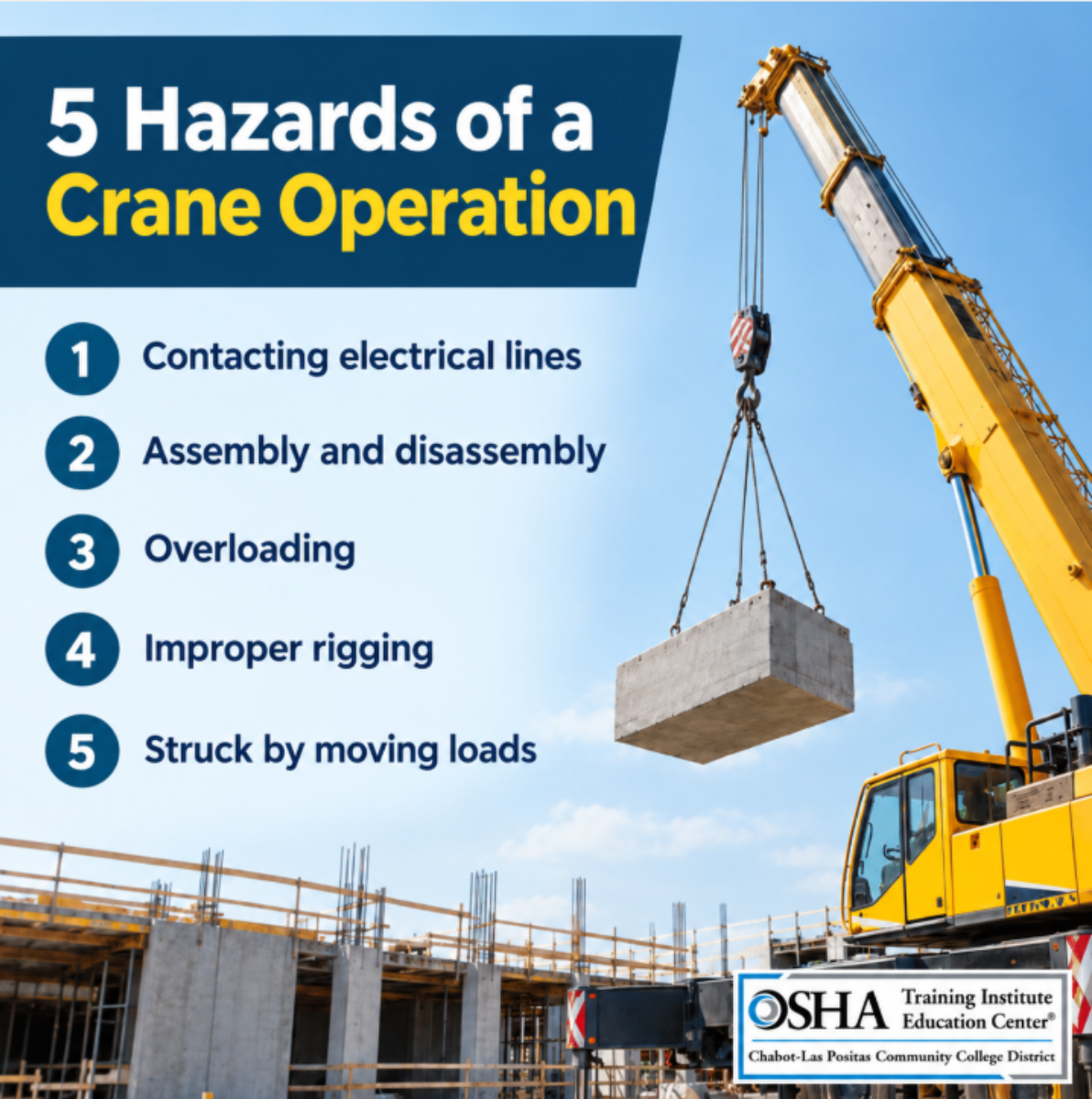
- What if the crane tips over? Where is everyone?
- What if the ground is too soft to support the crane and load?
- What if the operator isn’t experienced enough?
- What if there is a rigging failure?
- What if there is a miscalculation while reading the load chart?
Address every possible problem, including the most common crane hazards:
- The crane or load contacting electrical lines
- Assembly and disassembly errors
- Overloading the crane’s capacity
- Improper rigging
- A moving load striking employees
Providing crane safety training to keep employees safe
Companies must provide robust safety training for their employees, including any time they work on, with, or around a crane.
Training cannot be viewed as a one-time exercise, however. Companies should schedule regular trainings and repeat the courses as needed. Without regular crane safety training, employees can struggle to stay up to date on the latest regulations and best practices.
Similar to individuals, companies can tend to put all of their trust in their crane operators. No doubt, organizations need to evaluate and feel good about the operator, but they also need to look at the full gamut of what they’re trying to do and examine the fitness of each stage of the operation.
When developing a lift plan, create a system of checks and balances by including all parties involved with the crane pick. It’s simple: Everyone involved with the operation needs to be involved with the plan.
Don’t stop there. Communicate the plan to all affected by the lift, and inform them whether they may enter the area of the pick.
Improving crane safety culture
Crews must never aim to get the job done by any means necessary. The goal must be to keep everyone safe and get the job done correctly.
Safety is everyone’s responsibility. Managers need to build a workplace culture where everyone feels empowered to speak up and knows it’s their obligation to speak up, even when not involved in the operation.
I frequently had to say I wouldn’t work on a project because it’s unsafe, and multiple times in my career I walked off of projects after a supervisor or other colleague asked me to do something unsafe. Keeping each other safe is the duty of all workers.
If you feel something is off with an operation, trust your instincts, discuss it with supervisors, and re-evaluate. Managers should respond by stopping the operation, regrouping, and going over the plan again. If a crew member feels unsure, something is probably wrong. Take a fresh look at the situation, and ensure its safety before proceeding.
Every person on the crew has ownership of a project’s safety, and leadership needs to instill that authority. Safe projects prevent injuries, ensure successful operations, and protect the company’s reputation.
Learn more about crane safety training
Explore our crane safety course, OSHA #2055: Cranes in Construction. Gain insights on concepts of safe crane operations, common OSHA violations, and operational hazards and abatements.
If you find this information helpful, read our other posts on the Safety Blog.
Ike Riser is an OSHA Outreach trainer with extensive construction and safety experience. He has been instrumental in the success of award-winning safety programs, including for high-hazard projects. A noted speaker and former vice president of safety, Ike earned a degree in occupational health and safety, along with multiple health and safety certifications. In 2012, the Associated General Contractors of America presented Ike with their prestigious California Safety Professional of the Year award.